top of page

Updated: May 17, 2018

Doctor Who (BBC 1963-Present) is the longest running science fiction television series in history. Being produced for now fifty-five years, the show now has had over 276 stories spanning over 840 episodes. Having now had thirteen incarnations of ‘The Doctor’ the main character travelling through time and space, multiple rules, laws, and historical facts within the Doctor Who universe have been stated. However, multiple times within the series these rules, laws, and historical facts have been contradicted; meaning they go against the ‘canon’ of the franchise. I shall be exploring the contradictory story-line of the recent anniversary special, The Day of the Doctor, which aired on the 23rd November 2013 in comparison to the Russell T Davies era of Doctor Who.

I argue that the events of the Doctor Who fiftieth anniversary story can be considered as non-canon by the audience due to the fact the writer of this episode, Steven Moffat, changed story-lines created by another writer, Russell T Davies. Davies created the story line of ‘The Last Time War’ which was a war between the ‘Time Lords’, the Doctor’s species, and the ‘Daleks’, mutant aliens who have been the Doctor’s arch nemesis since the show began. Originally the end of the war depicted in the ‘Davies era’ was that Gallifrey, the Doctor’s home planet, was destroyed along with all his species the Time Lords. However, Moffat for the anniversary special changed the ending to Gallifrey being saved and the Time Lords surviving. To help analyse on whether these changes can be considered canon I shall look at episodes written by Davies which the Time War is mentioned and compare them to the anniversary special written by Moffat. To further analyse the fiftieth anniversary special, I shall also explore the recent book adaptation of the story penned by Moffat who also wrote the original television version. I shall be doing this to see which version should be considered as the definitive story. However, before I compare episodes written by the two writers I shall explore into the concepts of canon and textual poaching.
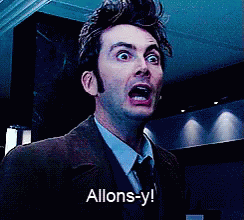


Poaching, by definition, is to take or acquire in an unfair or clandestine way. As seen at the end of my introductory post, I used a gif of the Tenth Doctor to set up this next post. Allons-y - French for let’s go - was used as a catch-phrase by David Tennant during his tenure as the title character. I used the gif in a way to say let's go and get on with the essay, not let's go and save the day as it was used within the episode. While this phrase was written for entertainment and only for consumption; I have however interpreted and repackaged it in my own way, as a fan, to provide narrative for this blog. This is an example of textual poaching, but what is textual poaching?

Textual poaching was a term first developed by Michael De Certeau in his book The Practise of Everyday Life (1984). De Certeau argues that audiences interpret individual meanings from media they have seen. This is due to everyone having unique situations and backgrounds. He goes on to say:

“readers are travellers; they move across lands belonging to someone else, like nomads poaching their way across fields they did not write, despoiling the wealth of Egypt to enjoy it themselves.” (De Certeau 1984, p174).


De Certeau has interpreted the audience as travellers venturing onto someone else’s land of imagination, interpreting the media they are consuming as they please. Possibly in a way it wasn’t intended to be. Even now, as I type about what De Certeau has written, I am textually poaching on his field of thought on the subject. Interposing my own ideology.

Henry Jenkins developed the study on textual poaching in his book, Textual poachers: television fans & participatory culture (1992). Jenkins states “it documents a group insistent on making meaning from materials others have characterized as trivial and worthless.” (Jenkins 1992, p3). Jenkins is describing that the audience members who consider themselves fans of a film or television series take materials like characters, information, and laws and can expand on them. Fans make theories or fiction pieces, often referred to as ‘fan fiction’, and have full creative control over the characters or happenings within these. Fan fiction is a fiction written by a fan which uses characters from a popular television series or film. This is to them connecting further with the text, none the less this is a form of textual poaching. This textual poaching blurs the line between consumer and producer as fans have the power to interpret what can happen next to a character. Sometimes fan culture is controlled by what is shared to greater audiences over the internet. For example, Warner Bros closed many Harry Potter fan websites as they owned the rights and didn’t like fans creating non-official content. However, companies who own the intellectual property can never completely stop textual poaching as it is an uncontrollable occurrence.

Fans can create any content they like while sticking close or as far away from the canon of the franchise as they want because they have the control. Fans can create any piece of text from a franchise and there’s no authority that can ultimately control them. This work by all the fans is never considered as ‘canon’ by the producers of the show or by other fans of the show, but can it be?


In my next post I shall be looking into the concept of canon to fully understand what it is and the power it holds.


Updated: May 17, 2018

Canon, simply, is a way of defining what is true and what isn’t true within a franchise's universe. However, it can be far more complex than this. As we have already seen from analysing textual poaching, fans can take control over the media that they consume and interpret it as they please. Not only fans can do this, producers and writers also choose on whether to ignore, or interpret differently previous information stated within the franchise they’re making.


Will Brooker analyses what canon is in his book Hunting the Dark Knight: Twenty-First Century Batman. Brooker states,


“Canon is not absolute gospel but a database that allows for constant tweaks, reboots and revisions.” (Brooker 2012, p158).


Here Brooker is describing that canon is a general guideline for producers and fans to follow. Producers and writers of the show have the most power and final say over what becomes canon. Changes can in fact be made while previous information goes ignored. Producers do this to help continue the story, or sometimes by mistake of not realising previous information in the franchise existed. The information they create in new episodes gets added to the franchises universe and fans can choose whether to accept the new information or ignore it. Canon is the base-plate of the universe of a franchise but within a large television series like Doctor Who, some facts which were originally true are suddenly going to become untrue. But what do fans do when information becomes contradictory over what has happened before within the franchise? Fans have two options. The first, ignore the latest rule and concentrate on what happened before as the true canon. Nonetheless, some facts are more difficult to ignore than others as I shall be looking into later. The other option is to accept the latest information but create or find a believable reason as to why this change has occurred. This choice is down to each individual fan watching the show. So every fan shall have a unique idea of what the canonicity is within the franchise. This can be seen when talking with the fans of Doctor Who. Paul Cornell, a fan, but most importantly a writer of Doctor Who episodes explains his view on canonicity in the show.

Paul Cornell

Cornell mentions the ‘Time War’ as the event which caused all historical events to alter within the universe, including previous Doctor Who adventures. Cornell concludes that


“There was never and now cannot be any authority to rule on matters of canonicity in a tale that has allowed, or at the very least accepted, the rewriting of its own continuity.” (Cornell 2007)


However, while Cornell has an excellent argument he is still just one voice in a crowd of Doctor Who fans giving their opinion on the franchise. Some could argue that as a writer for the show, Cornell’s say on the canon is greater than fan’s opinions. Yet, as we’ve seen from textual poaching this isn’t entirely true. The line between consumer and producer has become blurred so who decides on what is canon or not? Or even if canon in Doctor Who exists.


It’s time for me to analyse the two eras of modern Doctor Who to try and decipher on whether the story ‘The Day of the Doctor’ written by Steven Moffat should be considered as canon.


© 2023 by Web-Designer. Proudly created with Wix.com

bottom of page